
Blog, Uncategorized
Vic Worlds 1968 Honda Cb750 Sandcast Prototype went under the Hammer at Las Vegas Auction
Feb
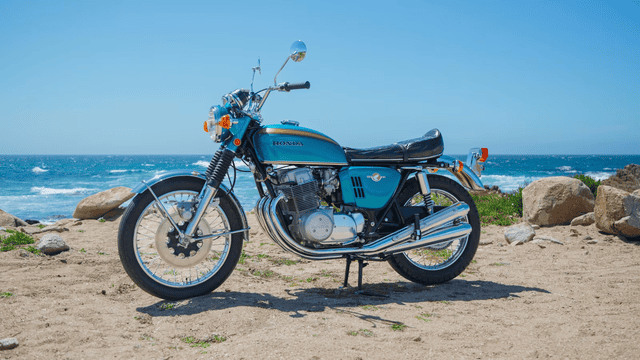
Discovering what remained of the one-and-only Honda CB750 prototype for sale in Southern California almost 30 years ago, Vic World knew he’d found a rare, one-of-a-kind machine, and this hard-to-come-by treat is now headed for the Mecum auction block in Las Vegas this January. Built in October 1968, Honda sent this prototype to the United States that very same month. The machine was also documented in a Cycle Guide magazine story shortly after, intended to generate excitement about the upcoming “new model” 4-cylinder Honda CB750.
World’s prototype, he said, should also not be confused with the four pre-production sample CB750s produced and delivered in January 1969 to Honda’s annual Dealer Convention in Las Vegas. The pre-production sample machines Honda sent to the Vegas convention looked and felt exactly like what dealers could expect to arrive in their showrooms. The 1968 prototype, conversely, is a one-of-one machine built entirely by hand and is, quite simply, the only one in existence.

“My prototype was produced and arrived here in October 1968,” World explained. “The prototype shares absolutely zero parts with the four pre-production samples and readily looks and functions quite differently, and is certainly nothing like what Honda wound up selling to the public.”
Locating and acquiring the prototype CB750 in the mid-1990s might have been the easy part. With the hurdles of a “perfect” and faithful restoration in mind, World didn’t immediately begin the project after bringing it to his World Motorcycles shop in San Bruno, California. In this facility, he’s dedicated his life to 4-cylinder Hondas and the sand-cast engine CB750 exclusively.
In the 1980s, World began purchasing as many of the 7,414 early-production CB750s featuring the famous sand-cast engine cases as he could find. Together with the sand-cast CB750s, World also acquired enough new old stock (NOS) Honda parts to restore these machines to factory condition and knows these bikes down to the tiniest details. To date, World has restored many sand-cast Honda CB750s and has also restored one of the pre-production samples.
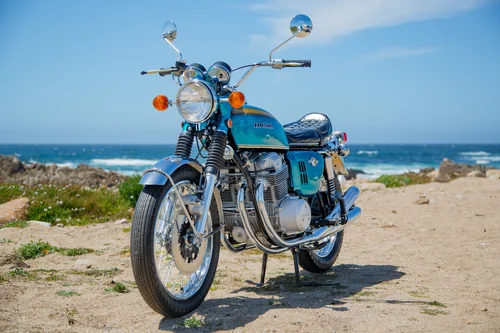


With his model-specific knowledge, World was ideally suited to rescue the prototype CB750 with its hundreds of parts that differentiate it from all other 4-cylinder Hondas. What is important to consider about the prototype, World said, is the level of experimentation Honda used in piecing together the machine.
“There are many trial-and-error parts used on this prototype motorcycle, and in Japan, they were trying to make up their mind about the way they wanted to go for the production CB750,” World explained. For example, consider the side covers.
On the right side of the bike, Honda obviously wondered how it would look with the airbox relatively exposed, and the cover is shorter. On the left, the airbox is completely covered with the side cover having an extended ear. World continued, “Those covers vary greatly in appearance, and Honda did all of this on one bike.”
Another example of an experimental component is the valve cover, as it features the word “HONDA” cast into it rather than “OHC 750” as used on every other CB750 produced. Yet another is the sand-cast front brake master cylinder having little fluid capacity as it utilized a steel line rather than rubber. Furthermore, this master cylinder is slanted inward toward the gauges. As a result, it contains too little brake fluid.


World said, “Honda was learning as they were going along, as this was their first bike with a disc brake. Afterward, Honda thought it better to increase the size of the master cylinder and, in consideration of how the bike would get serviced in daily use, to stand the cylinder more upright, making it easier to add fluid.”
The prototype is also the only CB750 ever produced where the seat is hinged at the rear and flips up from the front. To hold it upright, a stand bar needs to be employed, and it complicates the procedure.
“On production bikes,” World explained, “You simply release the latch and flip the seat sideways and forget about it. Again, I think they were learning/experimenting about what works and what doesn’t.”
He continued, “Basically, every piece except for the handgrips,” is different when compared to what World refers to as “street bikes,” or CB750s available to the public. He added, “They were testing their own waters, really, as they knew [with the soon-to-hit-the-market production CB750s] they had to hit a home run the first time out, and that they did!”

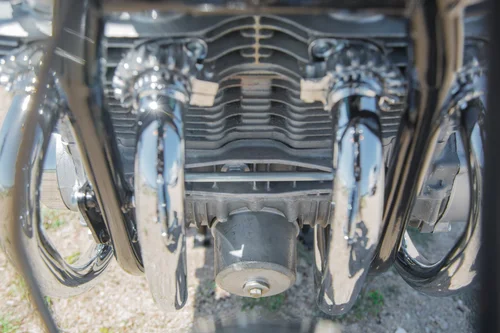
Also, from the billet crankshaft up, the engine of this prototype is narrower than production CB750s. World said this was most likely done as Honda would have been concerned about comfort for the average rider. To keep the transversely mounted inline-4 engine narrow, the crank features smaller journals with slender connecting rods. The cylinder spacing is more compact, and the cylinder head, with its wide-open spacing under the cam towers, bears no resemblance to street bikes. Rocker assemblies are also unique.
Other differences include the starter motor well and the stamped chrome cover that hides it. On street bikes, the well and its cover are rectangular. On the prototype, there’s a triangular “ear” at the one end, and the cover is shaped to fit.
“Probably one of the biggest examples of Honda’s trial-and-error approach are the carburetors,” World said. The carbs are a set of four one-off sand-cast Keihin units bearing little resemblance to those found on production CB750s. The prototype Keihins share one float chamber between two carburetors, making them, World said, “The most complex set of carbs I’ve ever seen in my life.
“If you want to get to a float, you have to remove the entire carb assembly, turn them over, and there are 24 screws to remove just to get to one float. There are so many moving parts that they quickly realized it’s way too complicated and determined each carb should have its own float bowl, and that proves advantageous. Production costs would also have been a consideration.”


Unique CB750 Prototype Details and Award-Winning Restoration
To quickly piece together the prototype, Honda borrowed components from its CL450 Scrambler parts bin, including a modified lower fork triple clamp. Also from the CL450 are the headlight ears featuring the sheet metal tabs to secure the drive cables for the speedometer and tachometer. These, and many other unique details, can best be seen at cb750prototype.com.
After beginning the prototype project in 2002, World finished the machine early in 2024. Restored to museum quality and correctly finished in Candy Blue-Green, the significance of the prototype was recognized at the 2024 Quail Motorcycle Gathering, where it won not only First Place Japanese but the highest honor: Best of Show. The CB750 prototype starts and runs but has not been ridden in consideration of its rarity. World’s prototype Honda CB750 represents a once-in-a-lifetime opportunity to acquire arguably the most important 4-cylinder Honda in existence.


So, when the hammer came down, I wasn’t surprised at the amount it fetched due to the rarity of this machine, although many thought it would fetch half a million, I believe them arket is very soft this year , but would not be surprised if we see this back up on the block in a few years time.
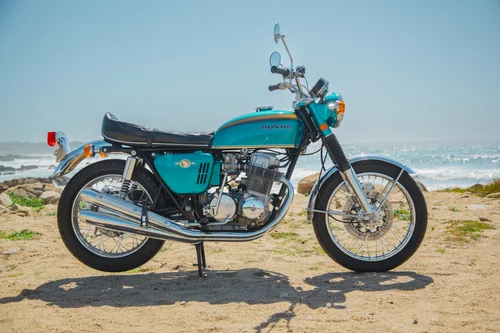
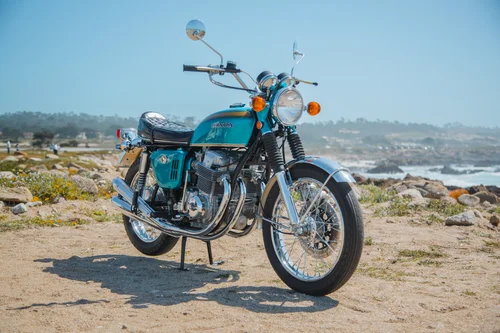

- Engine: 736cc SOHC, 4-stroke, air-cooled, 4-cylinder, 61 x 63 mm bore/stroke, 9:1 compression ratio, 67hp @ 8,000rpm
- Top Speed: 125mph
- Carburetion: 4 one-off, sand cast 28mm Keihin
- Clutch/primary: Multiplate oil bath, Hy-Vo chain
- Transmission: 5-speed constant mesh, chain final drive
- Starting: Kick starter and electric starter
- Electrics: Points and coil ignition, 12V alternator
- Frame/Wheelbase: Steel duplex tube frame, 57.9in (1470.7mm) wheelbase
- Suspension: Telescopic front forks, swingarm rear
- Brakes: 295mm single disc front, single piston caliper, 180.34mm drum rear
- Tires: 3.25-19in front, 4.00-18in rear
- Weight: 515lb (233.6kg) wet
- Seat height: 30in (762mm)
- Fuel capacity: 5.02gal (19ltr)

